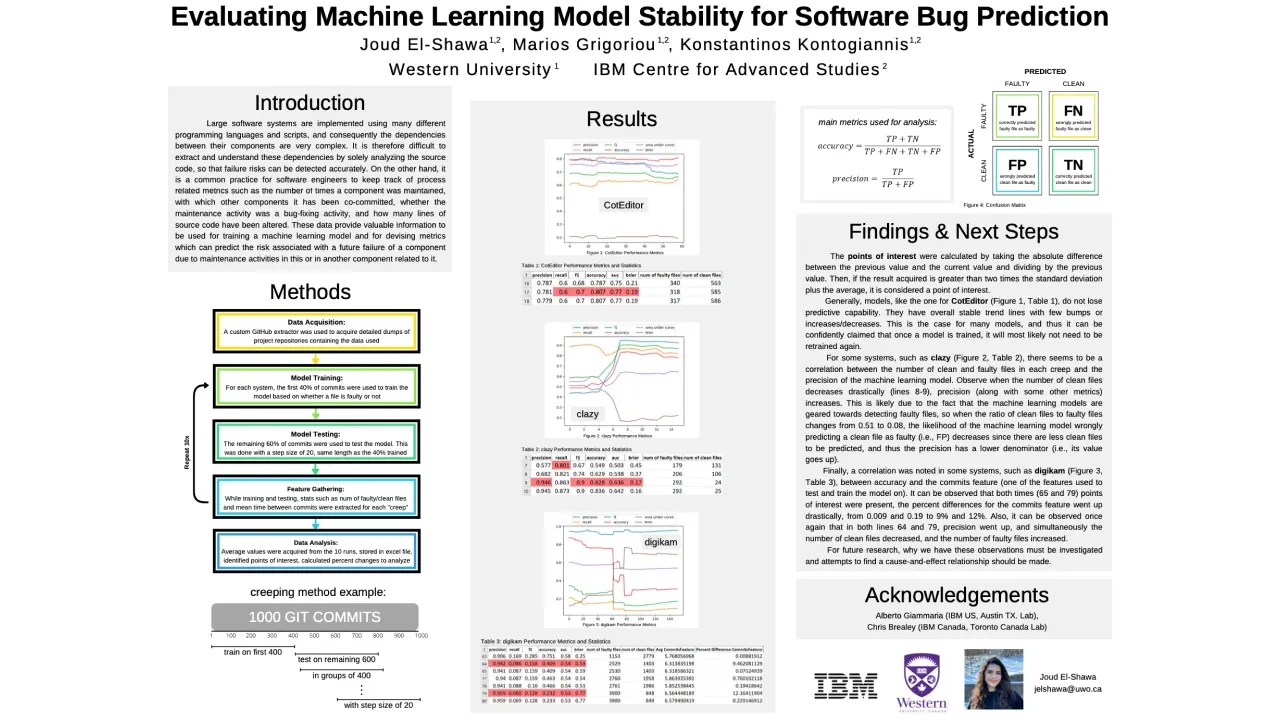
Large software systems are implemented using many different programming languages and scripts, and consequently the dependencies between their components are very complex. It is therefore difficult to extract and understand these dependencies by solely analyzing the source code, so that failure risks can be detected accurately. On the other hand, it is a common practice for software engineers to keep track of process related metrics such as the number of times a component was maintained, with which other components it has been co-committed, whether the maintenance activity was a bug-fixing activity, and how many lines of source code have been altered. These data provide valuable information to be used for training a machine learning model and for devising metrics which can predict the risk associated with a future failure of a component due to maintenance activities in this or in another component related to it.
In collaboration with IBM Centre for Advanced Studies and as part of my Western University Undergraduate Student Research Internship (USRI) under the supervision of Dr. Konstantinos Kontogiannis, I investigated the risk prediction of software system failures and evaluated the stability of machine learning models for software bug prediction. By utilizing process-related metrics, such as maintenance frequency, co-commitment with other components, bug-fixing activities, and lines of code altered, we trained a machine learning model to predict the risk of future failures due to maintenance activities.
A poster was created to summarize the findings and provide future direction. This was presented at the Western University Undergraduate Student Research Showcase.