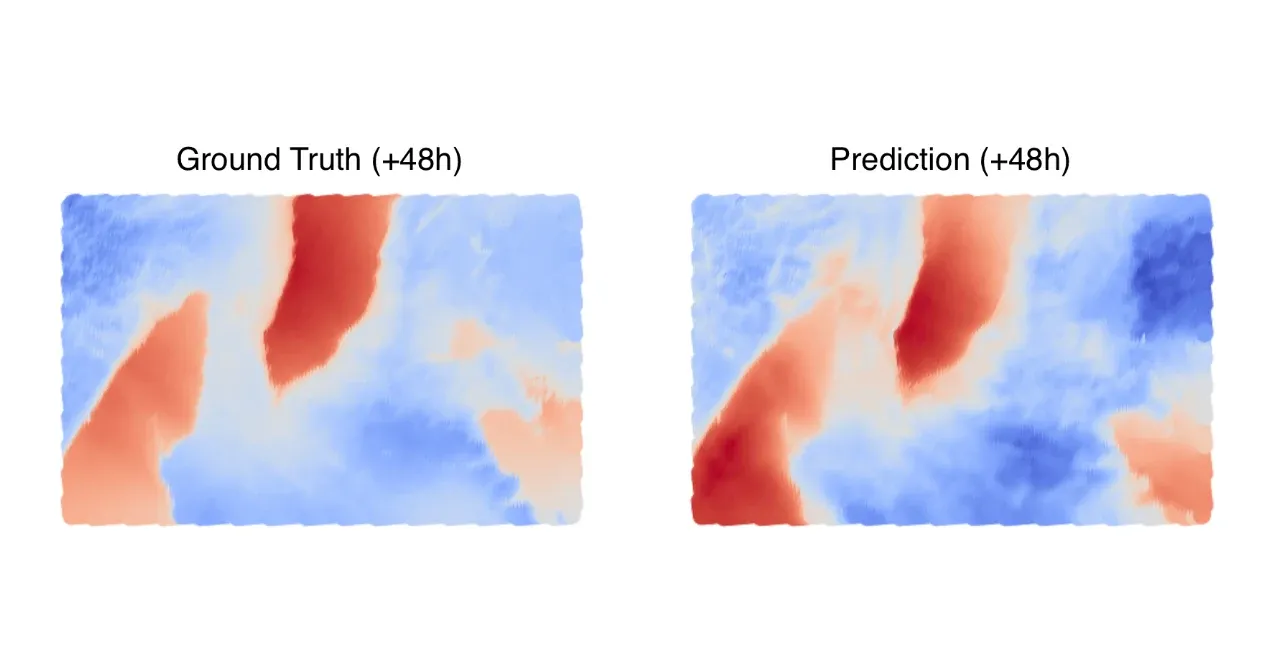
Heatwaves are intensifying worldwide and disproportionately affect marginalized communities in the Global South, where limited infrastructure and data availability hinder early-warning systems. This project introduces a Graph Neural Network (GNN) framework for high-resolution temperature forecasting, capturing spatial dependencies across thousands of grid points in Southwestern Ontario.
By learning spatial relationships through adjacency graphs, the model achieves a mean absolute error (MAE) of 1.93 °C (1–48 h forecasts) and 2.93 °C at 48 h, significantly improving upon traditional numerical weather prediction models. The framework is designed for transfer learning, enabling adaptation to data-limited regions.
This work was accepted to the NeurIPS 2025 Workshop on Tackling Climate Change with Machine Learning, where I presented a poster and recorded a short talk. The project lays the foundation for localized, equitable forecasting in resource-constrained settings.